The Cloud Conversation Has Changed:
OCI Is No Longer
Just About Moving to the Cloud
October 15, 2026
A few years ago, the enterprise cloud conversation was largely about migration. Should we move? What should we move? Which cloud should we choose? What will it cost?
Those questions have not disappeared, but they are no longer the most interesting part of the conversation. In 2026, cloud strategy is becoming less about choosing a destination and more about designing an operating model. IT leaders are making decisions about where critical workloads and data belong, how applications should connect across environments, what level of resilience the business requires and how much infrastructure their internal teams should continue to manage.
Oracle Cloud Infrastructure, or OCI, is evolving in response to that reality. For organizations running Oracle enterprise applications, that evolution is worth paying attention to.
The cloud is becoming less about location
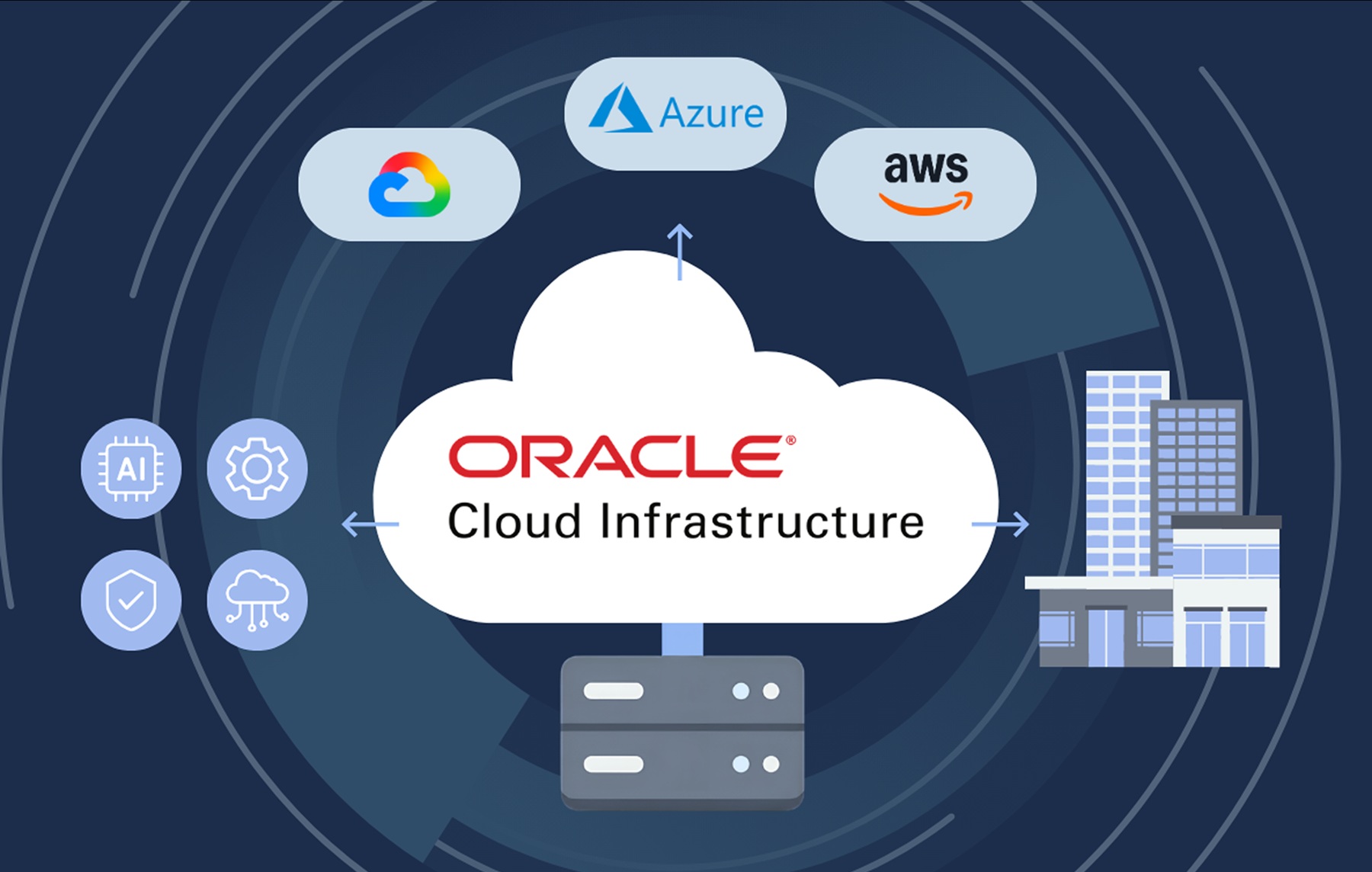
One of the clearest signals is Oracle's growing emphasis on multicloud. Oracle now makes its database technology available across OCI, AWS, Microsoft Azure and Google Cloud, allowing organizations to place Oracle data and database services closer to the applications, analytics platforms and AI services they already use. Oracle has also introduced Multicloud Universal Credits, providing a more consistent commercial model for Oracle AI Database services across multiple cloud environments.
That reflects a broader shift in enterprise cloud strategy. Most enterprises are already operating in the cloud, often in several clouds at once. The more useful question now is whether workloads are running in the environment that makes the most sense for the business.
That flexibility matters because enterprise environments rarely modernize all at once. A sound cloud strategy has to account for the technology an organization has today while creating room for where it wants to go next.
AI is making architecture more important, not less
AI adds another dimension to that conversation. As organizations connect enterprise data to generative AI, agents and other intelligent services, decisions about where data resides and how systems communicate become increasingly consequential. Data access, identity management, integration design, network architecture and security all become part of determining what AI can safely and effectively do.
For organizations running systems such as PeopleSoft, these considerations are particularly important. These applications often sit at the center of financial, HR, student, procurement and other critical business processes. Connecting them to new cloud and AI capabilities requires an understanding of the application as well as the infrastructure underneath it.
That is why cloud decisions increasingly cannot be made solely as infrastructure decisions. The application, database, integration and infrastructure layers have to be considered together.
Getting to OCI is only the first decision
There is another part of cloud strategy that receives considerably less attention than migration: what happens after the move.
Moving an inefficient architecture to the cloud does not automatically make it efficient. Workloads still need to be monitored, tuned and right-sized. Licensing decisions still matter. Disaster recovery needs to be tested. Security requirements continue to evolve, and costs need to be evaluated against actual usage.
HyperGen has seen this firsthand in complex Oracle environments. In one higher-education engagement, a client running PeopleSoft HCM, Financials and Campus Solutions moved from aging on-premises infrastructure to OCI. The environment was initially migrated to OCI RAC for high availability, but after stabilization, HyperGen transitioned it to a non-RAC configuration that maintained the required performance while reducing OCI operating costs by 40 percent.
Migration is a milestone,
not the finish line.
Getting workloads to OCI is one decision. Continuously evaluating whether the environment is still delivering the right balance of performance, resilience and cost is what turns a migration into a long-term cloud strategy.
Cloud maturity is becoming an operating model
The most successful cloud environments evolve as capacity, application requirements, security expectations and business priorities change. That requires organizations to think beyond infrastructure provisioning and consider how the environment will be operated over time.
HyperGen's OCI methodology reflects that progression, moving from discovery and design through migration and then into optimization and management. For organizations with lean Oracle or PeopleSoft teams, OCI managed services can also provide additional capacity for monitoring, patching, database administration, disaster recovery and ongoing optimization. The objective is not to outsource responsibility for the environment. It is to give internal IT the right balance of control, expertise and capacity.
That becomes more important as OCI supports more than traditional compute and storage. Database services, integration, security, analytics and AI are increasingly part of the same cloud foundation, making disciplined architecture and operations even more important.
The next cloud conversation
For IT leaders who moved to the cloud several years ago, this may be the right time to revisit assumptions made during the initial migration. For organizations still considering a move, it is an opportunity to think beyond the migration before it begins.
The conversation has matured. It is no longer simply cloud versus on-premises, nor is it necessarily OCI versus another hyperscaler. The more useful measure of cloud maturity is whether the architecture supports what the organization needs today while leaving room for what comes next.
Moving a workload to OCI can be an important step. What an organization does with the environment after it gets there is increasingly where the real cloud strategy begins.
